
With temperatures plummeting over the last month and records being set for coldest June temperatures across the country I’m sure many of you know only too well how clever the cold air can be at finding all the little holes, cracks and gaps in our houses to allow itself in.
Unfortunately, because our climate is typically fairly mild compared to many parts of the world, up until now Aussies have stuck to the mantra of “She’ll be right mate” and you just have to “toughen up” in winter. Having lived in very cold climates in Canada and the US where outside temperatures get down to -50ºC, I find myself colder living in Sydney where overnight temperatures never get below zero!
The reason we are feeling the cold is not because we need “toughen up” it’s because Australia has really leaky houses! CSIRO undertook a study of Australian homes and found that the average air change rate was 15.4ACH@50Pa with some houses reaching 30ACH@50Pa which is really leaky compared to international standards. Click here for details of the study.
The great thing is that fixing holes, gaps and cracks is a really economical way to improve your comfort and can save you up to 20% on your energy bills. Most of the work is DIY and materials can typically be bought at your local hardware store.
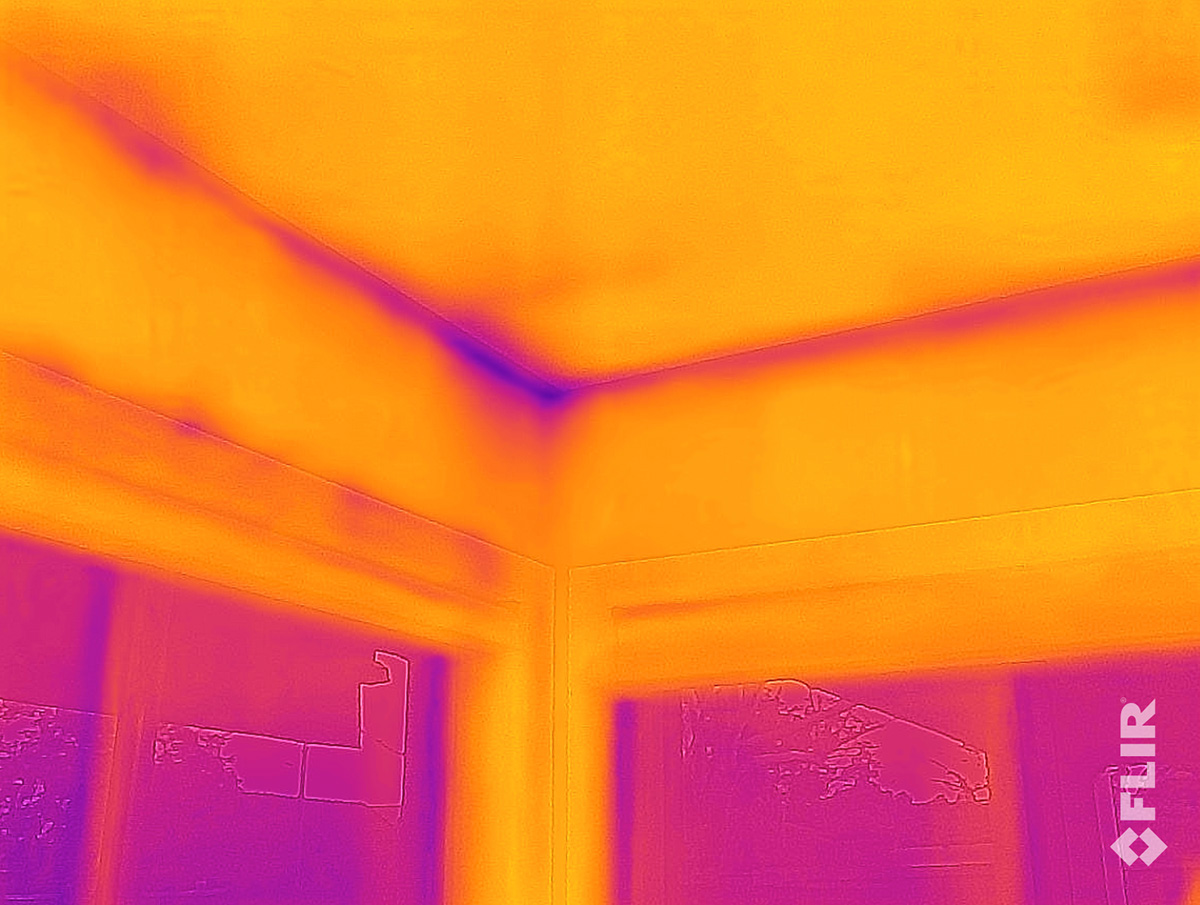
First thing you need to do is identify where the holes, gaps and cracks are. To do this go around each room and look for gaps around skirting boards, between floor boards, check along the sides of architraves, window and door frames, chimneys, vents and downlights. The thermal image shown here highlights the leak of cold air into the room from a gap at the ceiling/wall junction which is a very common location that needs sealing particularly with shadowline cornices. You can also see the leak of cold around the widow frames and yes also of course through the windows themselves!

Windows and external doors are a common source of draughts. Windows rattling and/or dust accumulating around the inside of the frames are both indicators that your windows need sealing. There are a variety of window and door seal products available at your local hardware and countless youtube videos to get you on the right track to installing them yourself. For a quick fix to fill a hole at the bottom of your door, use a door snake.
Use a caulking gun to seal up gaps around window frames and skirting boards and even around pipe penetrations in walls.
Unsealed exhaust fans can be retrofitted to seal when not in use, products like Draft Stoppa are readily available. If you can’t seal exhaust fans, be sure to keep the internal doors closed to these rooms.
Homes built prior to 1985 often have wall and ceiling vents. So long as you don’t have a portable un-flued gas heater or an open flued gas heater in the room, you can seal or remove these vents – even cardboard taped over them will do the trick!
For those with gaps in floor boards, the simplest thing to do is to install carpet or rugs. Alternatively, if you have access under the floor you can install insulating boards or foil to seal those gaps.
Finally, the big one – downlights. Halogen and older style incandescent downlights account for a significant amount of holes in our homes. They can be easily replaced with LED fittings which don’t leak and have the added benefit of using a lot less electricity to run – not to mention the advantage of not interrupting the ceiling insulation but that’s a story for another day!
Have fun filling those holes, gaps and cracks, you’ll notice the difference straight away and although those hot summer days seem a long way away now, soon enough we’ll be trying to keep the cold air in and you’ll be patting yourself on the back for having sealed all those holes, gaps and cracks!
